
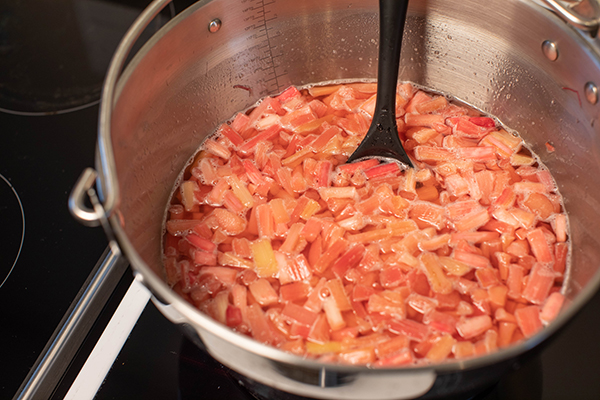
We are very excited to be launching our ‘Timperley Rhubarb Soft Set Preserve’ this week. It is made with forced Rhubarb handpicked from E.Oldoyd and Sons farm in the famous Rhubarb Triangle near Leeds.
Until now, we have offered principally Jams in our range, such as our ‘Blackcurrant and Juniper Jam’ or festive season top seller ‘Damson and Mulled Wine Jam’. With the creation of our first ‘soft set,’ there have been many conversations around the differences between jam and a preserve. That can then open a whole Pandora’s box of definitions when we start taking Compotes, Conserves, Coulis and Jellies into consideration. So here is a whistle-stop tour of everything so deliciously fruity, sweet and divinely traditional, especially on our Breakfast table.
Jam Definition
To dive in, we must go straight to the Food Standard Agency’s 5,000 words ‘The Jam and Similar Products (England) Regulations 2003’ definition. To legally be called a jam, the recipe must contain a minimum of 60% sugars (including natural fruit sugar and added sugar). It must contain a minimum of 35% fruit (although some fruits with lower pectin levels are allowed 25%, such as our ‘Blackcurrant and Juniper Jam’. This is the only fixed anchor definition and is enforceable legally.
Along comes our ‘Timperley Rhubarb Soft Set Preserve’, which is delicately sweet and of such incredible quality. We decided to add less sugar to keep it fresh and have a smooth, soft set consistency ideal for breakfasts in yoghurt and granola or porridge. The sugar content is well below the 60% required to be a jam, and hence we have called it a ‘soft set preserve’, which is precisely what it is.
Coulis and Compote
Since launching the soft set preserve, we have then been asked if it might be a Coulis or Compote if not a Jam. Ultimately no, as both involve slow cooking methods whereas we only cook our Rhubarb very briefly. Both involve adding some sugar and slow cooking, and reducing fruit. The Coulis is puréed so smooth, whereas a Compote has all the fruit within it. The challenge is that if there is not enough sugar, the fruit will not preserve and not last. Loosely then, our Rhubarb Preserve might only be seen as a Compote style.
Conserve
So is it a conserve then! Simply no. Conserves are a Preserve or Jam that includes more than one type of fruit, such as a Mixed Berry Conserve or similar.
Jellies
And finally, we have jellies which are also sweet, such as our seasonal ‘Mint Jelly’ or ‘Crabapple Jelly’. These are clear in consistency and made from boiling down apples or crabapples to extract the pectin, which is then boiled to 103 degrees, the magic temperature in preserving cooking. They are a standout preserve in method and consistency from the jam world.
And finally
We looked to provide you with a quick whistle-stop tour of preserves. As we began to pen some notes and research further, we discovered a whole world of fascinating stories, history, science, acidity and pectin, Ph levels, the magic of 103. We will expand on these further is a Fruit Preserve Series in the coming months.
Bee Wilson, a favourite food writer of ours, described in her FT article ‘Why Jam is Worth Preserving’ that making jam was an ‘Embalming the Seasons using Sugar”. We love that term and see ourselves perhaps as sugar embalming specialists who love eating our preserves as much as we do making them. Next up Part 2 – The History of Jam.