
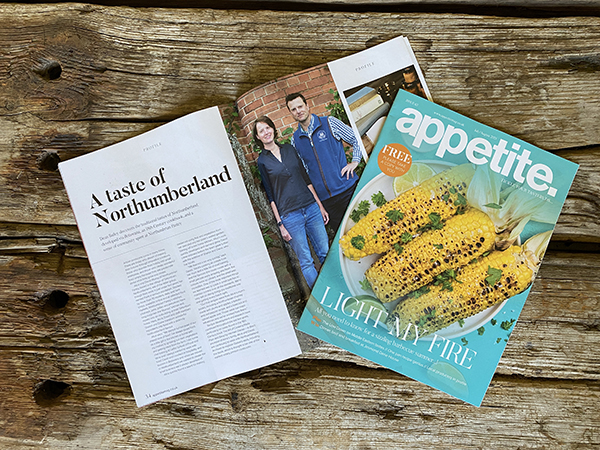
We are very proud to feature in the July / August edition of Appetite Magazine, a publication dedicated to the taste of the North East, showcasing the food and drink of the region.
The magazine is published eight times a year and can be picked up free in cafes, delis, farm shops and restaurants throughout the North East region.
Dean Bailey wrote a wonderful piece, ‘A Taste of Northumberland’, covering our journey from the early beginnings of Northumbrian Pantry.
For further reading, please follow the link to the online magazine or find us in the many magazines distributed in shops in the area:
www.appetitemag.co.uk/appetite-63-july-august-2021
A huge thank you to the whole Appetite magazine team and, in particular, Dean and Joanne O’Neil, who arranged the article.
Dean’s complete write can be found below:
A taste of Northumberland
Discovering the traditional tastes of Northumberland via Botswana, an 18th Century cookbook and community spirit at Northumbrian Pantry
Artisan producers come in many forms. There are those who dream of making their fortune through innovative creations, those who stumble from hobby into small enterprise, and those who create wonderful food simply because they are passionate about what they grow and create.
Alice and David Murray of Northumbrian Pantry – based in the village of Simonburn, Northumberland – are part of the latter group, though their work in just under two years has earned them a serious reputation already. Now stocked in more than 70 food shops, delis and farm shops as well as available online and at a limited number of food markets, Northumbrian Pantry’s range of relishes, chutneys, jams, jellies and preserves have long outgrown the Murray’s kitchen and moved into an outbuilding at their Simonburn home, where Alice and David along with staff members Sharon and Diane work with fabulous produce to create food with distinctly Northumberland flavour.
“We’ve already come so far,” says Alice. “We started out because of our shared love of food. I’ve always loved food – right from when I’d spend time in the kitchen at home with my mother as a little girl, growing our own vegetables and getting meat from the farm. I did some chef training at Leiths School of Food and Wine too, but I hadn’t done much with that in my career.
“I always wanted to find a way into working with food. After David and I worked in hospitality and tourism in Botswana, we moved to Northumberland and wanted to create the small business we’d always dreamed of.”
“We looked at our skills and Alice very quickly found a talent for making preserves using fruit and veg from our own garden as well as what she’d get from her sister’s walled garden,” adds David.
Creating products in their home kitchen at first, Alice’s work quickly developed, and demand grew. David came on-board before the team grew further with the addition of Sharon and Diane, who live locally.
“We learned a lot very quickly,” says David. “Alice’s cooking all comes from her mum and a little bit of chef training, and the flavours she could create with a small jam pan were amazing and fresh, the colours were so vibrant, and the smell was incredible.
“One of the most important things we learned was we have to cook in small batches to maintain control over all the elements. We’re very set on doing things the traditional way and getting every batch right.
“Our first recipes were from Alice’s mum’s books, including a Northumbrian Chutney recipe made with plums and apples, a tomato and red pepper recipe, and a beetroot and spiced apple recipe. Those three were our major influences and we’ve worked from there.”
Recipe development and research have continued throughout the last two years, particularly on ideas found in the 18th Century book The Art of Cookery Made Plain and Easy by Hannah Glasse – a direct ancestor of Alice’s family. Alice and David are continuing to work with Northumberland Archives to explore Glasse’s work – including the book, which is thought to be one of the earliest widely printed cookbooks.
“We’ve got an original copy of the book, which we have to be very careful with,” says Alice. “We dove into and came across the recipe for Paco Lilla, which is one of the very first references to what we know today as piccalilli. The recipe served as an inspiration for what we offer today as our Paco Lilla, though there we have to make a few changes – like not leaving things out in the sun to dry for two days or never allowing the jar to be fully emptied – to meet modern food hygiene standards.”
Having outgrown their own garden, the walled garden and the trees and hedgerows around their village within a matter of months, Alice and David have had to grow their pool of suppliers and continue to work hard on developing local supply chains for their ingredients.
“We started off very simply with what was available in the garden,” says David. “Then we worked with what we could get from the walled garden and what we found while walking locally – particularly crab apples on the trees around the village, but we outgrew those supplies too. Today we work with our neighbour, who has a successful wholesale fruit and veg business, which works well for us right now.
“Our long-term goal is to work with local growers though. We have done some work already and have a fabulous grower for our red onions. We’re keen to find the opportunities to work with more people in our community who can use our orders to expand their own businesses.”
While Alice and David have a long-time passion for food, creating artisanal produce was all new to them in 2019. Professionals who met while working in Edinburgh, they moved to Botswana together to manage a luxury safari resort in the Okavango Delta before returning to Alice’s native Northumberland in 2014.
“The Okavango Delta is an unbelievable, wild and beautiful place and we had a life-changing time out there,” says David. “We would have never been able to go back to Edinburgh or London having had that experience, but Northumberland gave us the space we wanted and the close-knit community we’d loved being part of.”
“Living in Botswana really opened our eyed food-wise too,” adds Alice. “Using what’s in season and available around you is important there and we did some training so we could identify and use the bush fruits, water lily bulbs – which are a real speciality – and the amazing mushrooms which grow in termite mounds in the wet season – though you needed to get to them before the baboons.
“Those experiences and catering for people from all over the world with a team of highly talented chefs have definitely shaped what we do today.”
At home in Northumberland, the four-strong team is ambitious about growing their reputation as one of the region’s best artisan producers, though they’re guided by their desire to enjoy what they do and enhance their community.
“Developing our community is at the core of what we want to achieve,” says David. “We want to work with local suppliers and help them grow, employ local people and make truly local products.
“We’ll do things slow and steady, let them grow organically, and make sure we enjoy the whole journey.”