
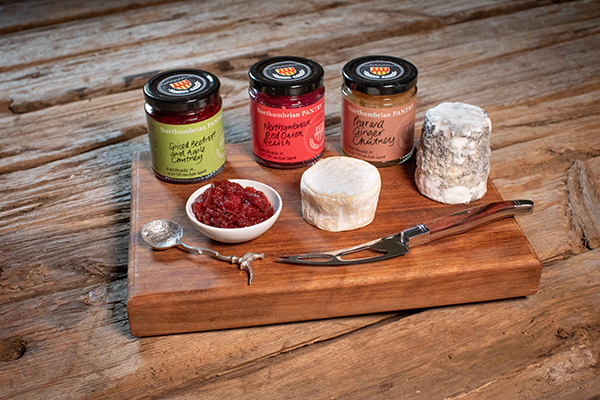
Goat, or chevre, must be one of the most unique of cheeses, setting itself apart on the cheeseboard in look, taste, aroma and even texture. We are great admirers, and always had it in mind when we designed our range, to ensure Goat’s cheese had its perfect ‘Pantry Pairing’.
When we meet our customers during chutney taste fayres and markets, we often describe the perfect pairings for our recipes. It is usually Goat’s cheese that divides people’s ‘love or loves less’ of cheese than any other.
Flavours range enormously depending on ageing, source of the milk, the food source for the Goat, and method of making. The stand out flavour might be tangy, earthy and with younger cheeses hints of citrus. It’s all in the capric acids and fatty acids which provide the distinct taste and aromas.
The textures vary from a light mouse to a more creamy and crumbly feel that comes with ageing. The appearance on a cheese board stands out with them often being cylindrical or in a roll and paler, more white in shade.
The perfect chutney and relish pairing for Goat will vary depending on the age and richness of the cheese. The level of sweetness is vital, but we do not need any further acidity or sharpness.
For a light mousy Goat’s cheese, we would recommend our ‘Pear and Ginger Chutney’. It is smooth and delicate with the ginger providing a subtle lift to the combination.
Our ‘Spiced Beetroot and Apple Chutney‘ must be the perfect of all Goat’s cheese pairings. Beetroot and Goat are a marriage made in heaven with the beetroot adding a wonderful contrasting colour and texture. For medium to aged cheeses, this is perfect.
The Northumbrian Red Onion Relish lends itself exceptionally well to Goat’s cheese salads, and we often use it on a goat’s cheese and red onion pizza.
Goat’s cheese has lower fat content than cows cheese, and lower lactose making it more easily digestible. It may be viewed at a more ‘healthy’ option and perhaps why we see feta, traditionally a Goat’s cheese, used in salads in Mediterranean dishes.
As you might imagine the making of the cheese has been documented as far back as 10,000 years, with it most likely being the first ever-dairy product of humankind. 70% of all Goat’s cheese is found in the Loire Valley of France, with over 1,000 producers in the whole country. It is thought that the Saracens introduced Goat’s to the Loire in the 8th century leaving the first recipes also.
There are many types of Goat’s cheese and methods of making it. It’s possible to produce blue, brie and soft varieties with it often aged in brine. We see so many different coatings also; from herbs, pintail oats, grapevines and even charcoal ash.
Goat’s are browsers, and amazingly the variations in flavours of the cheese are influenced more by the food of the goats than any other cheese. In the Loire Valley, it is said the cheese varies in taste with the territory of the region.
Goat’s cheese is also seen as a ‘summer cheese’, with it coming more alive in flavour as the goat feast on the lush green foods of the season.
We would recommend a light Italian Trebbiano, or citrusy Sauvignon-blanc, to partner a young fresh goats cheese with a butterier Chardonnay, distinct to California or Chile perhaps, for the more aged varieties.